Black drum
Pogonias cromis · Puppy drum (small ones), big uglies (the oversize), drum
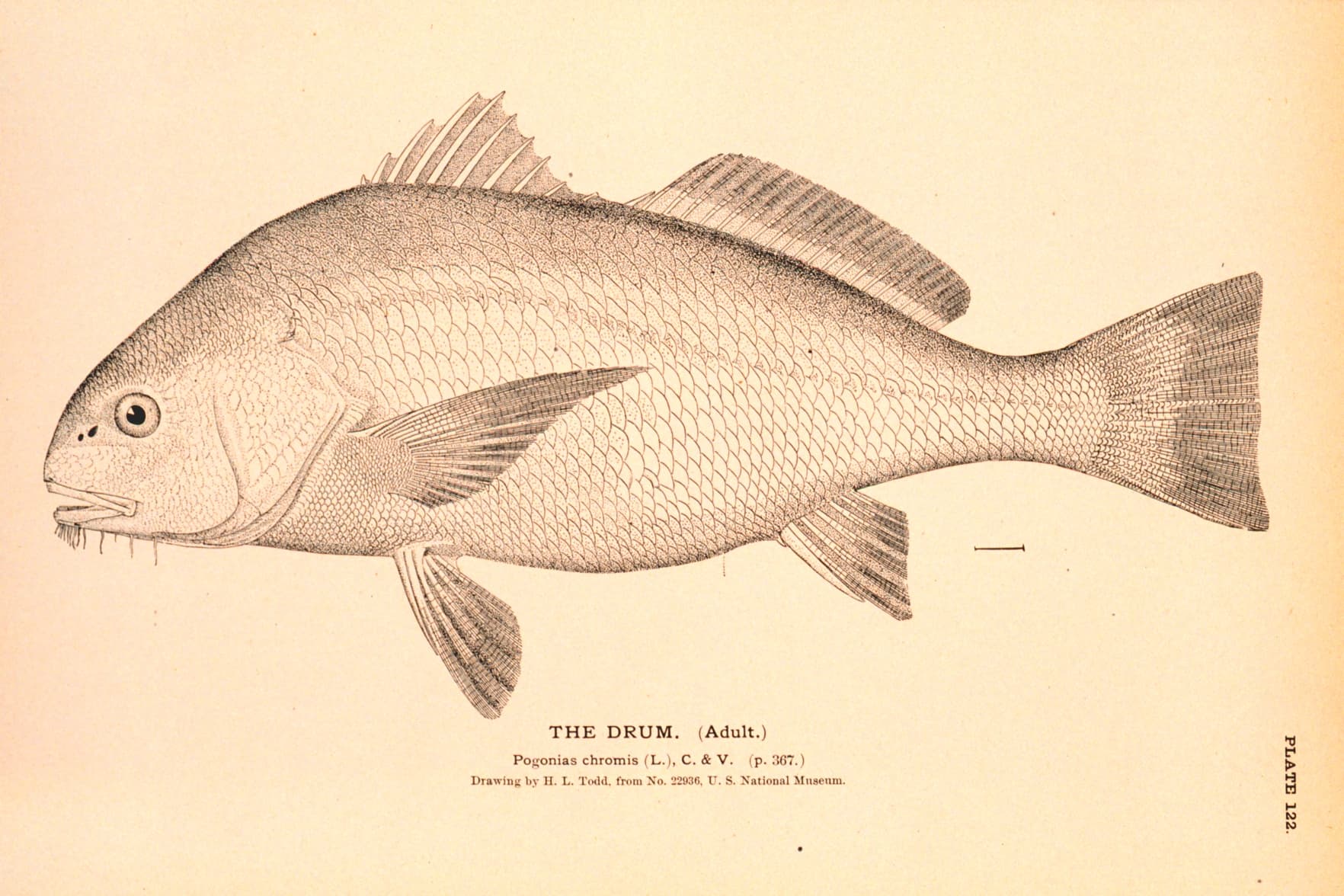
The winter fish of the Texas coast, and the easiest big fish to catch from a pier, a bank or a bay boat. Black drum crunch crabs and shrimp on the bottom, run in schools, and spawn in the passes and channels from late January into April when the water is too cold for much else. Slot fish (14–30 inches) are excellent on the table; the big breeders over 30 pounds are for the photo and the release.
October: GoodSlot drum mixed with reds along shorelines and in the back lakes.
TPWD rules · Sep 1, 2026 – Aug 31, 2027
- Daily bag
- 5 per day
- Size
- 14–30 inch slot
- Season
- Open all year
One black drum over 52 inches may be kept per person per day and counts toward the bag; most anglers release everything over the slot.
Check the current TPWD listing ↗At a glance
- Best months
- Feb–Apr for the big-drum run; Oct–Mar for slot fish; decent all year
- Water temp
- 50–80 °F; feeds in colder water than any other inshore fish
- Tide
- Moving water in the channels; the incoming on the flats
- Bottom
- Mud and shell, channel edges, pier pilings, oyster reefs
- Bait
- Cracked blue crab, dead or live shrimp, sea lice, fresh cut mullet (less so)
How to identify them
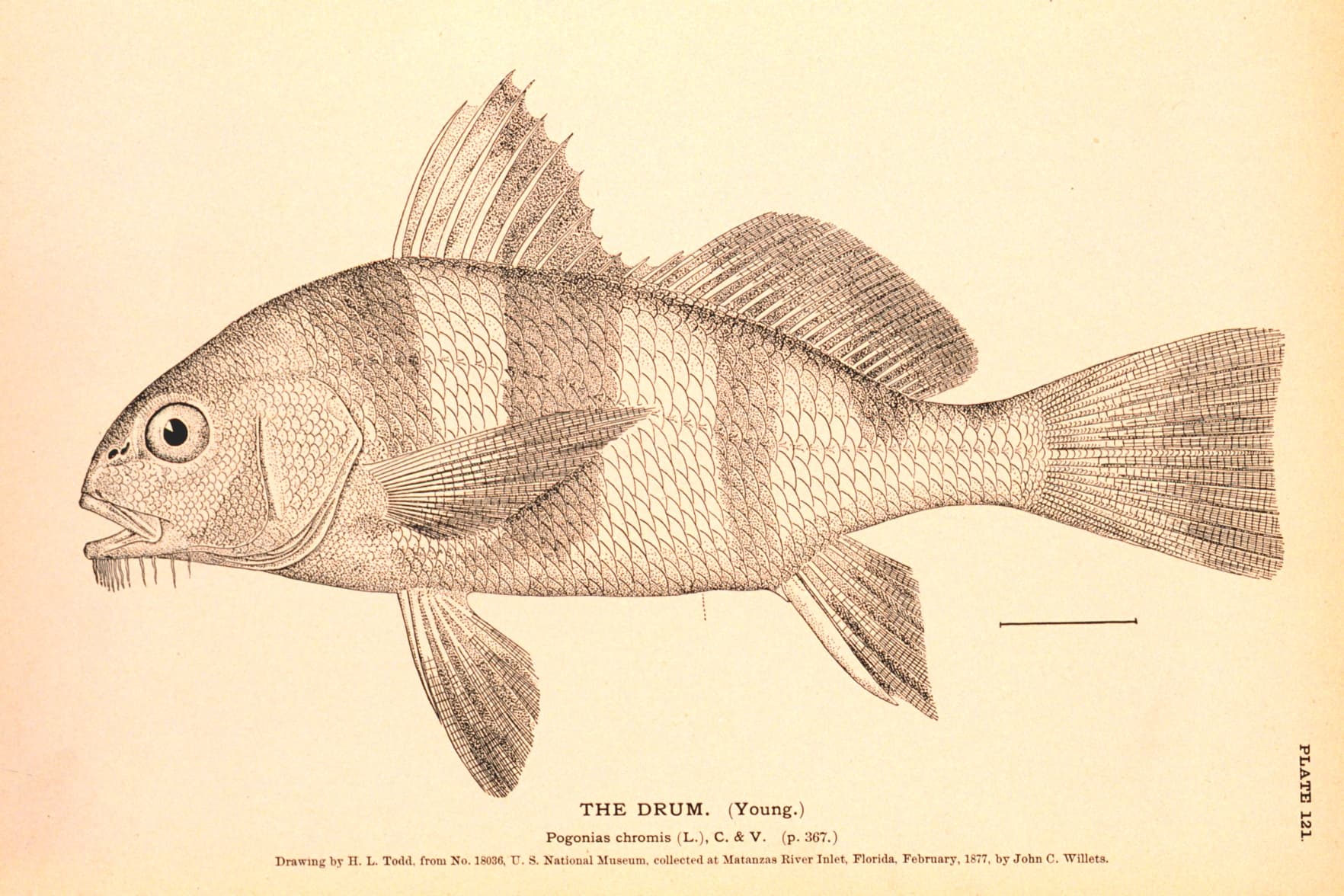
- Short, deep body with a high arched back and a blunt head.
- Rows of short barbels (whiskers) under the chin. Redfish and sheepshead have none.
- Young fish have four or five broad dark vertical bars that fade as they grow; big fish are plain gray, black or bronze.
- No sharp front teeth: they crush shellfish with flat plates in the throat.
Month by month
- JanGoodSlot drum on the shell and mud; the first big fish stage in the deep channels near the passes.
- FebPeakBig-drum run: ship channels, jetties, the Texas City Dike, Seawolf, the Causeway, Port Aransas, Port Mansfield.
- MarPeakPeak of the spawn; drum drumming audibly in the channels; piers and jetties loaded.
- AprGoodRun tapers; slot fish on reefs and flats; spring tides flood the marsh.
- MayFairScattered on reefs, wells, pilings and in the back lakes.
- JunFairJetties and deep shell; sight-casting tailing drum on the flats of the Laguna early.
- JulFairHot: deep reef, channel edges, night fishing under pier lights.
- AugFairSame; the flats of the Lower Laguna at dawn for tailing fish.
- SepFairFall feed begins on the reefs and shorelines with redfish.
- OctGoodSlot drum mixed with reds along shorelines and in the back lakes.
- NovGoodWinter pattern starts: mud and shell flats, bayou mouths, channel edges.
- DecGoodShell and mud in 3–8 ft; dead shrimp on the bottom; the Dike and the piers.
What 38 years of survey nets show
Every spring and fall since 1982, Texas Parks and Wildlife biologists have set the same overnight gill nets along the shorelines of every bay system from Sabine Lake to the Lower Laguna Madre, to track the fish. These charts are what 26,981 of those nets caught (1982–2019). Catch per net compares places, seasons and years; it isn't a count of fish.
Survey nets
26,981
1982–2019, spring and fall
Nets that caught black drum
87%
23,428 nets
Most per net lately
Upper Laguna Madre
64 per net, 2010–2019
Catch per net by bay system
2010–2019, spring and fall averaged. Nets catch more in murky water than clear, so treat close numbers as ties. Hover or tab to a bay for each season.
- Upper Laguna Madre64
- Lower Laguna Madre16
- Aransas Bay16
- San Antonio Bay16
- Corpus Christi Bay11
- Sabine Lake9.1
- Matagorda Bay8.6
- Galveston Bay6.8
Show the numbers
| Bay system | Spring 2010–2019 | Fall 2010–2019 | Spring 1982–2019 | Fall 1982–2019 | Nets |
|---|---|---|---|---|---|
| Upper Laguna Madre | 72 | 55 | 47 | 42 | 3,418 |
| Lower Laguna Madre | 16 | 17 | 14 | 17 | 3,408 |
| Aransas Bay | 15 | 17 | 14 | 16 | 3,420 |
| San Antonio Bay | 13 | 18 | 14 | 16 | 3,419 |
| Corpus Christi Bay | 13 | 9.9 | 13 | 11 | 3,420 |
| Sabine Lake | 8.3 | 9.9 | 6.7 | 10 | 3,058 |
| Matagorda Bay | 9.8 | 7.4 | 8.7 | 8.5 | 3,418 |
| Galveston Bay | 7.1 | 6.5 | 6.9 | 7.8 | 3,420 |
Coastwide, year by year
Average catch per net across the bay systems, spring and fall.
The 1984 drop followed the December 1983 freeze, which killed fish across the Texas bays.
Show the numbers
| Year | Spring | Fall |
|---|---|---|
| 1982 | 9.7 | 13 |
| 1983 | 13 | 8.4 |
| 1984 | 5.2 | 4.4 |
| 1985 | 4.7 | 7.2 |
| 1986 | 5.2 | 7.2 |
| 1987 | 6.2 | 5.3 |
| 1988 | 5.7 | 11 |
| 1989 | 6.5 | 17 |
| 1990 | 8.4 | 10 |
| 1991 | 13 | 15 |
| 1992 | 16 | 13 |
| 1993 | 21 | 23 |
| 1994 | 23 | 21 |
| 1995 | 17 | 23 |
| 1996 | 19 | 23 |
| 1997 | 19 | 18 |
| 1998 | 17 | 19 |
| 1999 | 16 | 15 |
| 2000 | 15 | 23 |
| 2001 | 22 | 20 |
| 2002 | 18 | 17 |
| 2003 | 17 | 15 |
| 2004 | 19 | 15 |
| 2005 | 17 | 17 |
| 2006 | 15 | 15 |
| 2007 | 15 | 15 |
| 2008 | 16 | 21 |
| 2009 | 20 | 26 |
| 2010 | 22 | 19 |
| 2011 | 17 | 18 |
| 2012 | 18 | 15 |
| 2013 | 20 | 22 |
| 2014 | 19 | 18 |
| 2015 | 19 | 17 |
| 2016 | 17 | 15 |
| 2017 | 21 | 20 |
| 2018 | 20 | 19 |
| 2019 | 21 | 15 |
Salinity
Catch compared with the average at each salinity, with place and season accounted for. Most black drum came from 30–45 ppt water (shaded).
Show the numbers
| Salinity (ppt) | Catch vs average | Nets |
|---|---|---|
| 0 | 73% | 1,213 |
| 2.5 | 85% | 749 |
| 5 | 96% | 1,233 |
| 7.5 | 101% | 933 |
| 10 | 104% | 1,415 |
| 12.5 | 103% | 1,066 |
| 15 | 99% | 1,732 |
| 17.5 | 97% | 1,215 |
| 20 | 97% | 1,714 |
| 22.5 | 97% | 1,392 |
| 25 | 98% | 2,259 |
| 27.5 | 99% | 1,890 |
| 30 | 102% | 2,415 |
| 32.5 | 104% | 1,976 |
| 35 | 105% | 2,147 |
| 37.5 | 109% | 1,185 |
| 40 | 112% | 962 |
| 42.5 | 110% | 350 |
| 45 | 109% | 355 |
Water temperature
Catch compared with the average at each temperature, with place and season accounted for. Most came from 66–79°F water (shaded).
Show the numbers
| Water (°F) | Catch vs average | Nets |
|---|---|---|
| 66 | 105% | 437 |
| 68 | 106% | 597 |
| 70 | 108% | 810 |
| 72 | 107% | 1,124 |
| 73 | 104% | 1,503 |
| 75 | 102% | 1,873 |
| 77 | 102% | 2,297 |
| 79 | 98% | 2,729 |
| 81 | 94% | 2,883 |
| 82 | 93% | 2,974 |
| 84 | 94% | 2,985 |
| 86 | 97% | 2,850 |
| 88 | 97% | 1,872 |
| 90 | 94% | 885 |
When young black drum show up
Small black drum per bag-seine haul along the shoreline, by month (2002–2016). Most in Apr, May, Jun.
Show the numbers
| Month | Per haul |
|---|---|
| Jan | 0.01 |
| Feb | 0.04 |
| Mar | 0.05 |
| Apr | 1.1 |
| May | 1.0 |
| Jun | 1.0 |
| Jul | 0.48 |
| Aug | 0.24 |
| Sep | 0.17 |
| Oct | 0.09 |
| Nov | 0.05 |
| Dec | 0.02 |
Survey hot spots on our map
Spots where the survey model expects the most black drum per net (2010–2019 average). The live scores use this as one factor, next to today's water, wind and tide.
Spring (Apr–Jun)
- 1.Kaufer-Hubert Memorial Park Pier (Cayo del Grullo)142
- 2.Kleberg Point Rocks (Baffin Bay)139
- 3.Center Rocks (Baffin Bay)129
- 4.Comitas Lake (Alazan Bay)127
- 5.Starvation Point (Baffin Bay)124
- 6.Rocky Slough (Baffin Bay)112
Fall (Sep–Nov)
- 1.Black Bluff Bar (Baffin Bay)108
- 2.Los Corrales (Baffin Bay)106
- 3.Rocky Slough (Baffin Bay)105
- 4.Center Rocks (Baffin Bay)102
- 5.Summer House Flats (Middle Ground)98
- 6.Starvation Point (Baffin Bay)93
Numbers: expected black drum per survey net.
Sources: TPWD gill net survey and bag seine survey (Texas Parks and Wildlife Coastal Fisheries, archived at BCO-DMO). Salinity, temperature and hot spots come from a model trained on these nets and checked on survey years it never saw; it ranks places inside a bay with a correlation of 0.93 on those years. Nets are set in spring and fall only, so summer and winter aren't sampled.
Where to find them
Ship channels, passes and jetties
The big spawners: the Houston Ship Channel near the Texas City Dike and Seawolf Park, the Galveston jetties and channel, the Sabine jetties, the Freeport channel, the Matagorda Ship Channel, the Aransas channel and Port Aransas jetties, the Mansfield Cut, the Brownsville Ship Channel and Brazos Santiago jetties. Fish the channel edge in 15–30 ft and the deep bends.
Piers, dikes and causeways
Texas City Dike, Seawolf Park, the 61st Street and Galveston fishing piers, Copano Causeway, Port Aransas and Bob Hall piers, the Queen Isabella Causeway. Drum hold around the pilings and in the channels under the structures.
Reefs and mud flats
Slot drum graze mud and shell flats in 2–6 ft, often with redfish: East Bay and Trinity Bay reefs, West Bay shell, the Matagorda reefs, Copano and Aransas Bay reefs, the Upper Laguna's mud. Look for muds (clouded water where they root) and tails on calm days.
Back lakes and bayous
Winter slot fish stack in deep bayous and back-lake channels, and in the marsh drains with redfish in fall.
How to catch them
Bait
Blue crab is the number one bait for big drum: a half crab (shell off, legs on) or a quarter of a big one, hooked through a leg socket. Dead shrimp (peeled, two on a hook) catches slot fish all winter. Fresh, oily and on the bottom beats everything artificial; drum feed by smell and the barbels under their chin.
Rig
Fish-finder rig with a 1–4 oz egg or pyramid sinker (more in the channels), 30–50 lb leader 12–24 in, 3/0–5/0 circle hook for slot fish, 7/0–9/0 for the big ones. Keep the bait still on the bottom; let the fish pull the rod down and reel into it. Rattle corks with shrimp work on the flats.
Lures and fly
Not a lure fish in dirty water, but on clear flats, tailing drum eat a slowly crawled Gulp crab or shrimp, a small jig tipped with shrimp, and crab flies. Drop it a foot in front of the fish and barely move it.
Tackle
Slot fish: a medium spinning outfit with 15–20 lb braid. Big drum in the channels: 7'–8' medium-heavy, 4000–6000 reel, 30–50 lb braid, 50 lb leader; a long-handled net.
Reading the conditions
Temperature
Black drum keep feeding into the low 50s, which is why they carry the winter. The spawning run follows water warming from the upper 50s into the 60s from late January; a warm week in February turns it on.
Tide
Channel fish feed on moving water, either direction, with the bite picking up as the current starts and fading at slack. On the flats, the incoming floods the shell and the drum follow it.
Wind and clarity
Drum don't care about clarity; a stiff north wind in February that muddies the channels doesn't stop the run, but it makes the piers and jetties uncomfortable. Pick the lee side.
Fronts
The day before and the warm days between fronts are best. Immediately after a hard front, the fish drop into the deepest water and feed lightly until the sun warms things up.
Tips from the water
- Fresh bait wins. Buy crab the morning of the trip, keep it cold, and change baits every 20 minutes.
- Fish the drop. On a channel, the edge where 8 ft falls to 20 is the lane; in the middle you catch hardheads.
- Listen. In the spring run you can hear the drumming through the hull or the pier planks; stay on the sound.
- Puppy drum under 24 inches are the eating fish; the meat of big drum is coarse and often carries spaghetti worms (harmless, but not appetizing).
- On the flats in the Laguna, drum tails are broader and more rounded than a redfish's; approach quietly and lead them.
- Bring a measuring board and a camera; a 30-inch fish is longer than most people guess.
Common mistakes
- Setting the hook hard on a circle hook when the rod loads.
- Fishing frozen, washed-out shrimp when live or fresh-dead is available.
- Casting into the channel's deep middle instead of along the ledge.
- Keeping a big breeder; it tastes poor and the slot protects the fishery.
Handling and release
Big drum are durable but heavy; support the belly, keep them horizontal and in the water as much as possible, and revive them before release. Slot fish for the table go straight on ice; trim the dark meat and the fillets are firm and sweet.
Use it today
By port: Sabine · Bolivar · Galveston · Freeport · Sargent · Matagorda · Port O'Connor · Rockport · Port Aransas · Corpus Christi · Port Mansfield · South Padre
Other species
Regulations change: confirm bag and size limits in the TPWD Outdoor Annual before you keep a fish. Not for navigation.