Flounder
Paralichthys lethostigma · Southern flounder, flatfish, doormats for the big ones
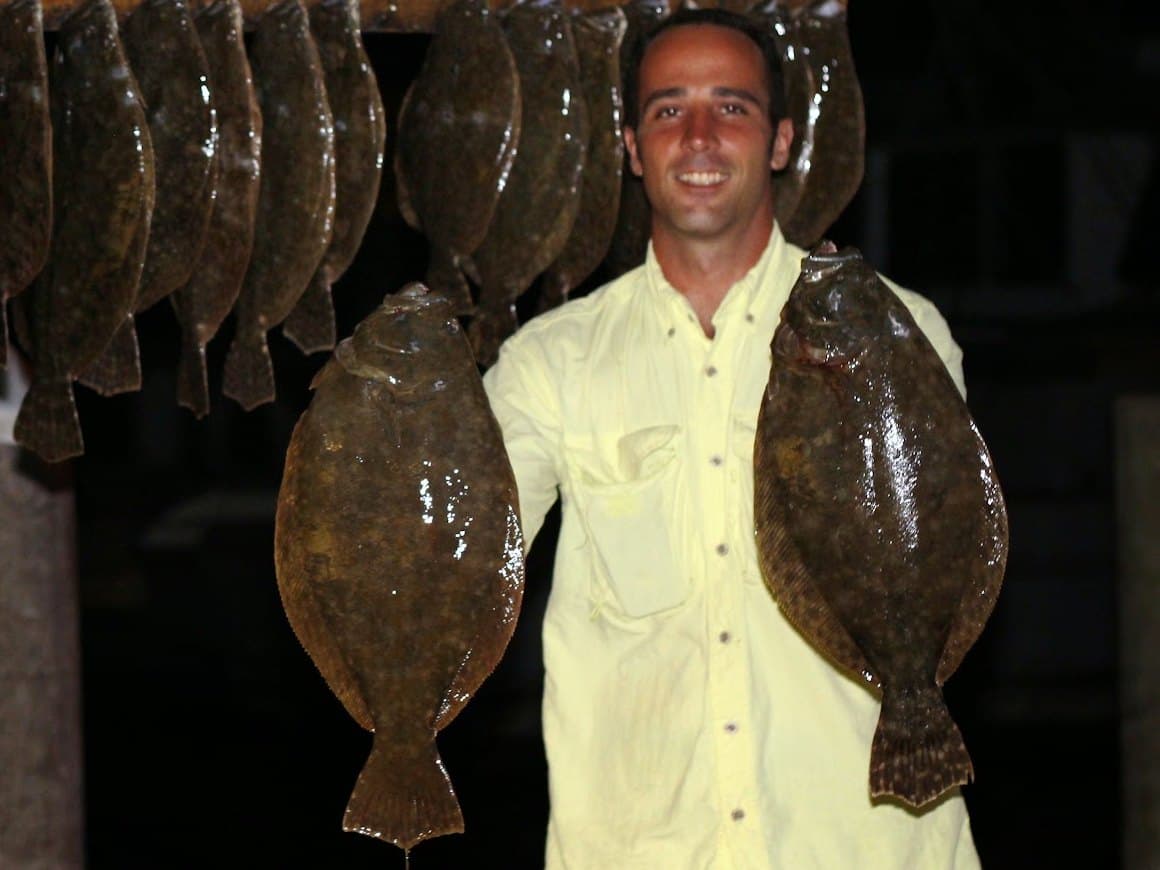
An ambush fish that lies on the bottom at the edge of current and waits. Flounder fishing is about structure and tide: the lip of a drain, the sand next to a jetty rock, the edge of a channel where the bottom turns from mud to sand. The fall run, when every flounder in the marsh moves to the Gulf to spawn, is the best fishing of the year and also when TPWD closes the season to protect them.
October: PeakThe run. Every drain, bayou and pass on outgoing tides after each front; the ICW at the passes.
TPWD rules · Sep 1, 2026 – Aug 31, 2027
- Daily bag
- 5 per day
- Size
- 15 inch minimum
- Season
- Closed Nov 1 – Dec 14 (bag 0, catch and release only)
The closure protects the fall migration. Gigging and hook-and-line both close. Flounder gigging licenses and lights have their own rules; check TPWD.
Check the current TPWD listing ↗At a glance
- Best months
- Oct and the first days of Nov (run), Dec 15–Jan (return trickle), Mar–Apr (spring return)
- Water temp
- 60–78 °F; the run triggers as water drops through the mid-60s
- Tide
- Outgoing at drains and passes; the last of the ebb at the jetties
- Bottom
- Sand and mud edges with current: drain lips, channel ledges, jetty washouts, pier pilings
- Presentation
- Slow. Drag it, hop it, stop it. Most bites feel like weight.
How to identify them
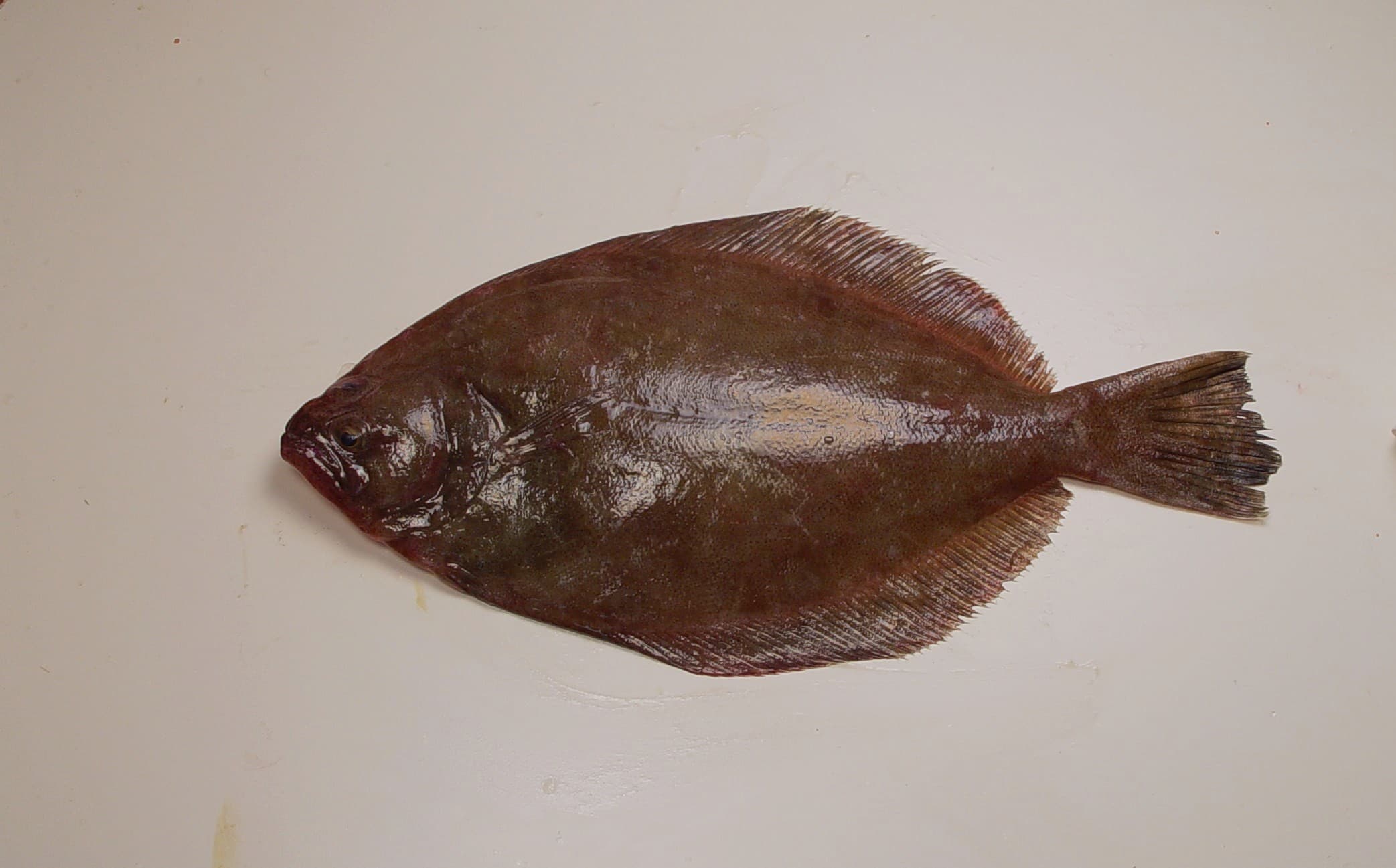
- Flat, brown on top and white underneath, with both eyes on the left side of the head.
- A big mouth full of sharp teeth; the jaw reaches past the back of the eye.
- Southern flounder, most of what's in Texas bays, have scattered pale and dark blotches but no sharp eyespots. Gulf flounder have three distinct eyespots in a triangle.
Month by month
- JanFairFish return from the Gulf; deep channels near the passes and the jetties on warm days.
- FebFairPasses and channel ledges; mud minnows on the bottom in 8–15 ft.
- MarGoodSpring run back into the bays: drains, bayou mouths and marsh edges as water warms past 60.
- AprGoodSpread through the bays; shorelines near drains, the edges of grass and sand.
- MayFairScattered on shorelines, reef edges and pier pilings; gigging improves on calm nights.
- JunFairShallow sand at night for giggers; by day, pilings, jetties and drains on the outgoing.
- JulFairHot-water pattern: the jetties, pass edges and deep drains early and late.
- AugFairSame, plus the surf guts behind the bar on calm days.
- SepGoodThe staging begins: bayou mouths and drains hold more fish each front.
- OctPeakThe run. Every drain, bayou and pass on outgoing tides after each front; the ICW at the passes.
- NovPeakSeason closed Nov 1–Dec 14: catch and release only. The best fishing of the year goes back.
- DecFairReopens Dec 15; the first fish return through the passes late in the month.
What 38 years of survey nets show
Every spring and fall since 1982, Texas Parks and Wildlife biologists have set the same overnight gill nets along the shorelines of every bay system from Sabine Lake to the Lower Laguna Madre, to track the fish. These charts are what 26,981 of those nets caught (1982–2019). Catch per net compares places, seasons and years; it isn't a count of fish.
Survey nets
26,981
1982–2019, spring and fall
Nets that caught flounder
35%
9,349 nets
Most per net lately
San Antonio Bay
0.62 per net, 2010–2019
Catch per net by bay system
2010–2019, spring and fall averaged. Nets catch more in murky water than clear, so treat close numbers as ties. Hover or tab to a bay for each season.
- San Antonio Bay0.62
- Galveston Bay0.55
- Sabine Lake0.55
- Lower Laguna Madre0.49
- Aransas Bay0.47
- Matagorda Bay0.38
- Corpus Christi Bay0.37
- Upper Laguna Madre0.34
Show the numbers
| Bay system | Spring 2010–2019 | Fall 2010–2019 | Spring 1982–2019 | Fall 1982–2019 | Nets |
|---|---|---|---|---|---|
| San Antonio Bay | 0.32 | 0.91 | 0.43 | 1.2 | 3,419 |
| Galveston Bay | 0.41 | 0.70 | 0.55 | 0.91 | 3,420 |
| Sabine Lake | 0.33 | 0.78 | 0.30 | 0.79 | 3,058 |
| Lower Laguna Madre | 0.32 | 0.67 | 0.55 | 0.99 | 3,408 |
| Aransas Bay | 0.28 | 0.66 | 0.41 | 0.80 | 3,420 |
| Matagorda Bay | 0.23 | 0.52 | 0.38 | 0.78 | 3,418 |
| Corpus Christi Bay | 0.28 | 0.46 | 0.45 | 0.79 | 3,420 |
| Upper Laguna Madre | 0.29 | 0.38 | 0.40 | 0.57 | 3,418 |
Coastwide, year by year
Average catch per net across the bay systems, spring and fall.
The 1984 drop followed the December 1983 freeze, which killed fish across the Texas bays.
Show the numbers
| Year | Spring | Fall |
|---|---|---|
| 1982 | 0.95 | 1.9 |
| 1983 | 0.94 | 1.4 |
| 1984 | 0.59 | 1.2 |
| 1985 | 0.95 | 1.5 |
| 1986 | 0.74 | 1.4 |
| 1987 | 0.58 | 1.3 |
| 1988 | 0.54 | 1.1 |
| 1989 | 0.39 | 1.0 |
| 1990 | 0.39 | 1.2 |
| 1991 | 0.82 | 1.2 |
| 1992 | 0.39 | 0.99 |
| 1993 | 0.35 | 0.90 |
| 1994 | 0.32 | 0.78 |
| 1995 | 0.30 | 0.75 |
| 1996 | 0.46 | 0.68 |
| 1997 | 0.41 | 0.70 |
| 1998 | 0.56 | 0.60 |
| 1999 | 0.37 | 1.1 |
| 2000 | 0.47 | 0.86 |
| 2001 | 0.31 | 0.56 |
| 2002 | 0.49 | 0.86 |
| 2003 | 0.49 | 0.61 |
| 2004 | 0.38 | 0.88 |
| 2005 | 0.39 | 0.57 |
| 2006 | 0.31 | 0.59 |
| 2007 | 0.13 | 0.39 |
| 2008 | 0.41 | 0.78 |
| 2009 | 0.28 | 0.64 |
| 2010 | 0.21 | 0.64 |
| 2011 | 0.57 | 1.2 |
| 2012 | 0.50 | 0.90 |
| 2013 | 0.27 | 0.37 |
| 2014 | 0.20 | 0.60 |
| 2015 | 0.42 | 0.78 |
| 2016 | 0.27 | 0.65 |
| 2017 | 0.21 | 0.34 |
| 2018 | 0.16 | 0.32 |
| 2019 | 0.28 | 0.53 |
Salinity
Catch compared with the average at each salinity, with place and season accounted for. Most flounder came from 20–45 ppt water (shaded).
Show the numbers
| Salinity (ppt) | Catch vs average | Nets |
|---|---|---|
| 0 | 70% | 1,213 |
| 2.5 | 82% | 749 |
| 5 | 89% | 1,233 |
| 7.5 | 89% | 933 |
| 10 | 90% | 1,415 |
| 12.5 | 93% | 1,066 |
| 15 | 96% | 1,732 |
| 17.5 | 99% | 1,215 |
| 20 | 104% | 1,714 |
| 22.5 | 110% | 1,392 |
| 25 | 114% | 2,259 |
| 27.5 | 112% | 1,890 |
| 30 | 109% | 2,415 |
| 32.5 | 107% | 1,976 |
| 35 | 107% | 2,147 |
| 37.5 | 108% | 1,185 |
| 40 | 105% | 962 |
| 42.5 | 106% | 350 |
| 45 | 110% | 355 |
Water temperature
Catch compared with the average at each temperature, with place and season accounted for. Most came from 66–73°F water (shaded).
Show the numbers
| Water (°F) | Catch vs average | Nets |
|---|---|---|
| 66 | 107% | 437 |
| 68 | 111% | 597 |
| 70 | 114% | 810 |
| 72 | 113% | 1,124 |
| 73 | 107% | 1,503 |
| 75 | 100% | 1,873 |
| 77 | 94% | 2,297 |
| 79 | 91% | 2,729 |
| 81 | 90% | 2,883 |
| 82 | 88% | 2,974 |
| 84 | 88% | 2,985 |
| 86 | 92% | 2,850 |
| 88 | 98% | 1,872 |
| 90 | 107% | 885 |
When young flounder show up
Small flounder per bag-seine haul along the shoreline, by month (2002–2016). Most in Mar, Apr.
Show the numbers
| Month | Per haul |
|---|---|
| Jan | 0.01 |
| Feb | 0.13 |
| Mar | 0.30 |
| Apr | 0.23 |
| May | 0.09 |
| Jun | 0.06 |
| Jul | 0.05 |
| Aug | 0.03 |
| Sep | 0.03 |
| Oct | 0.03 |
| Nov | 0.02 |
| Dec | 0.01 |
Survey hot spots on our map
Spots where the survey model expects the most flounder per net (2010–2019 average). The live scores use this as one factor, next to today's water, wind and tide.
Spring (Apr–Jun)
- 1.Trinity River Mouth (Trinity Bay)1.7
- 2.Jack's Pocket (Trinity Bay)1.0
- 3.Summer House Flats (Middle Ground)0.87
- 4.Gas Wells (Trinity Bay)0.86
- 5.Chocolate Bay Shoreline (West Bay)0.78
- 6.Mouth of the Land Cut (Middle Ground)0.78
Fall (Sep–Nov)
- 1.Dewberry Island (Espiritu Santo Bay)3.8
- 2.Saluria Bayou (Espiritu Santo Bay)3.5
- 3.Midway Reef (Espiritu Santo Bay)3.0
- 4.Big Pocket (Espiritu Santo Bay)2.9
- 5.Matagorda Peninsula Shoreline (West Matagorda Bay)2.3
- 6.Shoalwater Bay (Espiritu Santo Bay)2.2
Numbers: expected flounder per survey net.
Sources: TPWD gill net survey and bag seine survey (Texas Parks and Wildlife Coastal Fisheries, archived at BCO-DMO). Salinity, temperature and hot spots come from a model trained on these nets and checked on survey years it never saw; it ranks places inside a bay with a correlation of 0.87 on those years. Nets are set in spring and fall only, so summer and winter aren't sampled.
Where to find them
Drains and bayou mouths
The edge of the current where a drain empties: flounder lie on the down-current lip, facing into the flow, waiting for shrimp and mud minnows. Fish the first drop and the eddy behind any point. In October, every drain between the marsh and a pass is a stop on the migration.
Passes, channels and the ICW
Sabine Pass, Rollover Pass area, the Galveston channel edges, San Luis Pass, the Brazos and San Bernard river mouths, Mitchell's Cut, the Colorado River, Pass Cavallo, Cedar Bayou, the Aransas and Lydia Ann channels, the Mansfield Cut, Brazos Santiago. Fish the ledge where the channel drops, not the deep middle.
Jetties and piers
Sand pockets between the rocks, the washouts, the edge where rock meets sand, and the channel side on the last of the outgoing. Pier pilings on the bay side and surf side hold flounder all summer.
Shorelines and reefs
Spring and summer fish lie on sand and shell shorelines, especially where a gut runs parallel to the bank, and along the sand edge of oyster reefs.
How to catch them
Live bait
Mud minnows (killifish) and finger mullet are the standards: hook through the lips on a 1/4–3/8 oz jig head or a light Carolina rig and drag it slowly across the bottom. Live shrimp works but gets picked apart. When you feel weight, drop the rod tip, count to three (five for a big fish), then sweep; flounder grab the bait crossways and turn it before swallowing.
Soft plastics
Gulp shrimp, swimming mullet and curl tails (chartreuse, white, pink, new penny) on 1/4 oz jig heads; a 3-inch paddle tail hopped along the bottom with a small chunk of shrimp on the hook. Scent helps more with flounder than any other inshore fish.
Technique
Cast up-current, let it hit bottom, and crawl it back with short hops and pauses, keeping contact. Work every yard of a drain lip or a channel ledge in a grid; flounder don't move far to feed. Work the same spot on consecutive tide stages, the fish reposition as the water drops.
Gigging
Shallow sand and mud flats on calm, clear nights, especially spring and summer; a light, a gig, and a slow quiet walk or a lighted boat. Same bag and size rules; the fall closure applies.
Tackle
7' medium-light rod with a sensitive tip, 10–15 lb braid, 20 lb fluorocarbon leader; braid is worth it for feeling the pick-up. Kahle or wide-gap hooks (1/0–2/0) on Carolina rigs.
Reading the conditions
Tide
Outgoing, outgoing, outgoing. Flounder feed when water drains off the marsh and through the drains; the last two hours of the ebb at a drain or jetty is the window. The incoming can be good at the passes as fish ride it back in during spring.
Fronts and temperature
In fall, each cold front that drops the water temperature a few degrees pushes another wave of fish toward the Gulf; the day of the front with the north wind draining the marsh, and the two days after, are the best. The run accelerates when water falls through 65 °F and is largely over below 55.
Wind and clarity
Flounder tolerate dirty water better than trout, but they feed by sight at close range, so stirred-up mud over the drain lip slows the bite. A north wind helps by draining the marsh; a hard south wind that floods it hurts.
Moon
The new and full moons around October bring the strongest tides and the biggest pushes of migrating fish.
Tips from the water
- Wait on the bite. The number one reason people miss flounder is setting the hook on the first thump.
- Fish slow and tight to the bottom; if you are not touching bottom you are not flounder fishing.
- Target the edges: where sand meets mud, where current meets slack, where the channel drops.
- Use a jig head with a wire keeper and a wide-gap hook; a flounder's mouth is big but set back.
- Carry a net. Flounder shake free at the surface more than any other fish, and they come off at the boat.
- After a front in October, fish the drain nearest a pass first, then work inland as the tide drops.
Common mistakes
- Fast retrieves and high rod tips that lift the bait off the bottom.
- Fishing the top of the flat instead of the drop at its edge.
- Keeping a 14-inch fish; measure, and remember the November closure.
- Ignoring the spring run back into the bays in March and April.
Handling and release
Flounder are hardy for release: wet hands, a quick unhook with pliers (teeth), back in the water. For the box, bleed and ice immediately; the fillets are among the best on the coast. A fish gigged is a fish kept, so be sure of size before you gig.
Use it today
By port: Sabine · Bolivar · Galveston · Freeport · Sargent · Matagorda · Port O'Connor · Rockport · Port Aransas · Corpus Christi · Port Mansfield · South Padre
Other species
Regulations change: confirm bag and size limits in the TPWD Outdoor Annual before you keep a fish. Not for navigation.