Speckled trout
Cynoscion nebulosus · Spotted seatrout, specks, yellowmouths; big ones are sows or gator trout
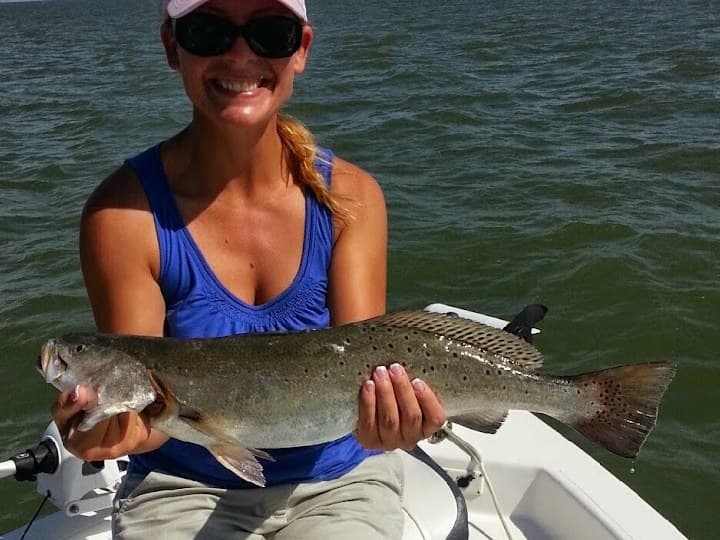
The fish most Texas bay anglers are after. Trout live their whole lives in the bays and passes, follow the bait and the water temperature through the year, and reward anglers who pay attention to moving water, wind and the season's pattern more than any other species. A 15–20 inch slot and a three-fish bag mean the game now is quality over numbers.
October: PeakPrime fall: drains and bayou mouths on outgoing tides, mud-and-shell flats, working birds.
TPWD rules · Sep 1, 2026 – Aug 31, 2027
- Daily bag
- 3 per day (possession 6)
- Size
- 15–20 inch slot
- Season
- Open all year
One trout over 28 inches per license year with a completed Spotted Seatrout Tag, plus one more with a Bonus tag (digital tags are reported in the Texas Hunt & Fish app).
Check the current TPWD listing ↗At a glance
- Best months
- Apr–Jun and Oct–Nov; the biggest fish Jan–Mar
- Water temp
- 60–82 °F; the bite slows under 55 and over 86
- Tide
- Any moving water; the first two hours of an incoming on the flats, outgoing at drains and passes
- Wind
- Under 12 kt is prime; fish the lee shoreline when it blows
- Light
- Dawn and dusk; overcast days extend the topwater bite
How to identify them
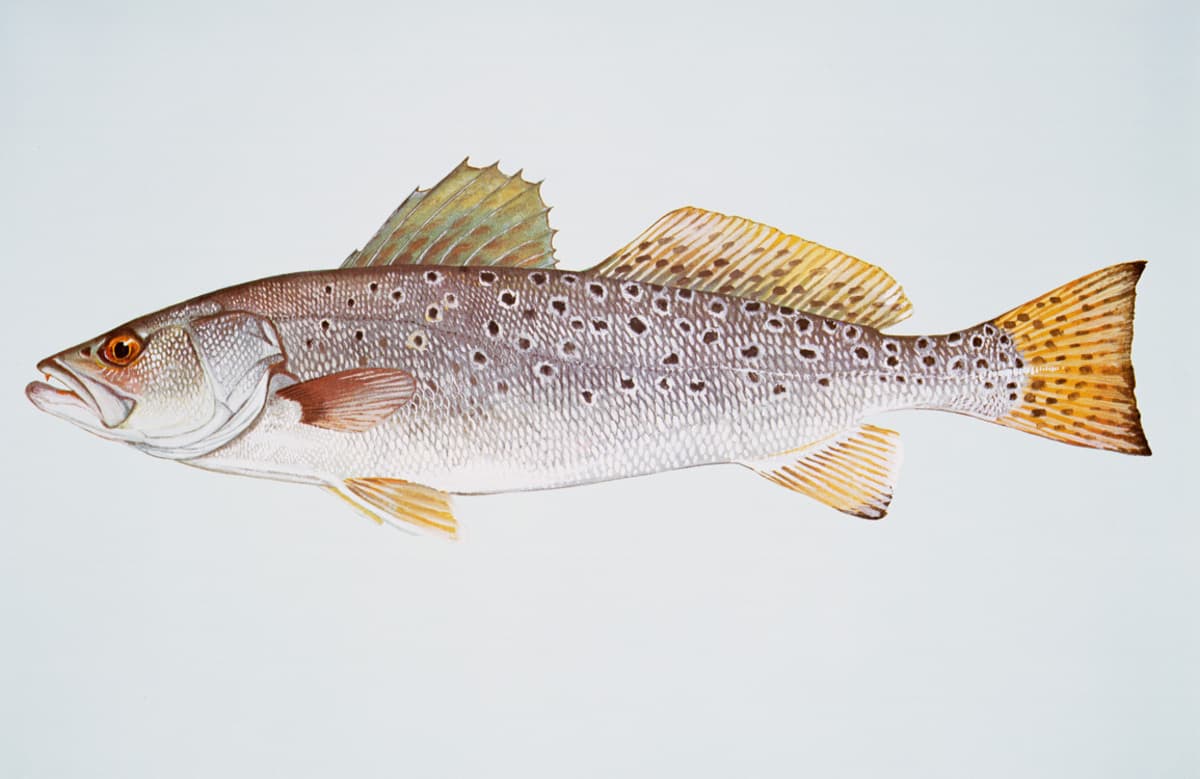
- Round black spots scattered over the upper back, the soft dorsal fin and the tail, and no spot at the base of the tail.
- One or two big canine teeth at the tip of the upper jaw; big fish have a yellow-orange mouth, hence "yellowmouth".
- Dark gray-green back and silvery sides. Sand trout are paler and tan, with no distinct spots.
Month by month
- JanFairBig trout on mud and shell in 3–6 ft, deep bayous and the ICW on warm afternoons; slow-sink plugs and big soft plastics.
- FebGoodTrophy month. Mud flats next to deep water warm first; wade slowly, Corkys and Paul Brown originals.
- MarGoodFish push up on shorelines as water hits 60 °F; topwater early on warm days, plastics after.
- AprPeakSpawning starts; guts, reefs and sand-and-grass flats; shrimp show up and the cork bite begins.
- MayPeakPeak numbers: reefs, wells, spoil islands and the surf when it goes green; croaker season starts.
- JunPeakEarly bite then deep structure; the surf on light southeast wind; night fishing under lights.
- JulGoodDawn only on the flats, then 6–10 ft wells, reefs and the passes; birds working over shrimp.
- AugFairHot water: deep shell, the jetties and the surf at first light; move early, quit by 10.
- SepGoodFirst fronts turn the bite on; birds over shrimp in the open bay; back lakes start to empty.
- OctPeakPrime fall: drains and bayou mouths on outgoing tides, mud-and-shell flats, working birds.
- NovPeakFish follow shrimp and mullet into the backs of bays; topwaters all day on overcast fronts.
- DecGoodDeeper shorelines and mud bottoms; the warm-up days between fronts fish best.
What 38 years of survey nets show
Every spring and fall since 1982, Texas Parks and Wildlife biologists have set the same overnight gill nets along the shorelines of every bay system from Sabine Lake to the Lower Laguna Madre, to track the fish. These charts are what 26,981 of those nets caught (1982–2019). Catch per net compares places, seasons and years; it isn't a count of fish.
Survey nets
26,981
1982–2019, spring and fall
Nets that caught speckled trout
86%
23,213 nets
Most per net lately
Lower Laguna Madre
13 per net, 2010–2019
Catch per net by bay system
2010–2019, spring and fall averaged. Nets catch more in murky water than clear, so treat close numbers as ties. Hover or tab to a bay for each season.
- Lower Laguna Madre13
- Corpus Christi Bay11
- San Antonio Bay11
- Upper Laguna Madre9.0
- Galveston Bay8.9
- Aransas Bay6.7
- Matagorda Bay6.6
- Sabine Lake5.1
Show the numbers
| Bay system | Spring 2010–2019 | Fall 2010–2019 | Spring 1982–2019 | Fall 1982–2019 | Nets |
|---|---|---|---|---|---|
| Lower Laguna Madre | 17 | 8.5 | 17 | 8.6 | 3,408 |
| Corpus Christi Bay | 15 | 7.0 | 12 | 6.3 | 3,420 |
| San Antonio Bay | 14 | 7.4 | 12 | 6.4 | 3,419 |
| Upper Laguna Madre | 13 | 4.9 | 9.7 | 5.0 | 3,418 |
| Galveston Bay | 12 | 5.5 | 10.0 | 6.0 | 3,420 |
| Aransas Bay | 9.0 | 4.3 | 9.5 | 5.1 | 3,420 |
| Matagorda Bay | 8.8 | 4.3 | 8.2 | 4.5 | 3,418 |
| Sabine Lake | 7.1 | 3.1 | 5.0 | 3.0 | 3,058 |
Coastwide, year by year
Average catch per net across the bay systems, spring and fall.
The 1984 drop followed the December 1983 freeze, which killed fish across the Texas bays.
Show the numbers
| Year | Spring | Fall |
|---|---|---|
| 1982 | 12 | 4.8 |
| 1983 | 9.9 | 5.0 |
| 1984 | 3.9 | 3.1 |
| 1985 | 6.6 | 4.5 |
| 1986 | 8.5 | 6.1 |
| 1987 | 8.7 | 4.8 |
| 1988 | 8.3 | 5.1 |
| 1989 | 7.6 | 4.1 |
| 1990 | 7.3 | 3.4 |
| 1991 | 9.7 | 5.6 |
| 1992 | 9.7 | 6.2 |
| 1993 | 10 | 6.0 |
| 1994 | 12 | 6.0 |
| 1995 | 9.0 | 5.6 |
| 1996 | 11 | 7.0 |
| 1997 | 12 | 6.4 |
| 1998 | 13 | 7.2 |
| 1999 | 12 | 5.9 |
| 2000 | 11 | 5.5 |
| 2001 | 13 | 7.0 |
| 2002 | 11 | 7.0 |
| 2003 | 12 | 5.8 |
| 2004 | 11 | 7.3 |
| 2005 | 11 | 5.4 |
| 2006 | 10 | 5.2 |
| 2007 | 12 | 7.2 |
| 2008 | 9.7 | 5.8 |
| 2009 | 8.4 | 4.8 |
| 2010 | 9.3 | 6.5 |
| 2011 | 12 | 5.7 |
| 2012 | 11 | 5.2 |
| 2013 | 13 | 5.1 |
| 2014 | 12 | 6.3 |
| 2015 | 12 | 5.2 |
| 2016 | 15 | 4.8 |
| 2017 | 10 | 5.7 |
| 2018 | 13 | 5.4 |
| 2019 | 12 | 6.2 |
Salinity
Catch compared with the average at each salinity, with place and season accounted for. Most speckled trout came from 12.5–32.5 ppt water (shaded).
Show the numbers
| Salinity (ppt) | Catch vs average | Nets |
|---|---|---|
| 0 | 79% | 1,213 |
| 2.5 | 84% | 749 |
| 5 | 89% | 1,233 |
| 7.5 | 92% | 933 |
| 10 | 99% | 1,415 |
| 12.5 | 106% | 1,066 |
| 15 | 111% | 1,732 |
| 17.5 | 113% | 1,215 |
| 20 | 115% | 1,714 |
| 22.5 | 115% | 1,392 |
| 25 | 114% | 2,259 |
| 27.5 | 113% | 1,890 |
| 30 | 109% | 2,415 |
| 32.5 | 103% | 1,976 |
| 35 | 101% | 2,147 |
| 37.5 | 98% | 1,185 |
| 40 | 92% | 962 |
| 42.5 | 85% | 350 |
| 45 | 83% | 355 |
Water temperature
Catch compared with the average at each temperature, with place and season accounted for. Most came from 68–84°F water (shaded).
Show the numbers
| Water (°F) | Catch vs average | Nets |
|---|---|---|
| 66 | 96% | 437 |
| 68 | 100% | 597 |
| 70 | 101% | 810 |
| 72 | 99% | 1,124 |
| 73 | 102% | 1,503 |
| 75 | 106% | 1,873 |
| 77 | 109% | 2,297 |
| 79 | 108% | 2,729 |
| 81 | 106% | 2,883 |
| 82 | 103% | 2,974 |
| 84 | 100% | 2,985 |
| 86 | 95% | 2,850 |
| 88 | 90% | 1,872 |
| 90 | 86% | 885 |
When young speckled trout show up
Small speckled trout per bag-seine haul along the shoreline, by month (2002–2016). Most in Sep, Oct, Nov.
Show the numbers
| Month | Per haul |
|---|---|
| Jan | 0.04 |
| Feb | 0.03 |
| Mar | 0.02 |
| Apr | 0.02 |
| May | 0.07 |
| Jun | 0.30 |
| Jul | 0.59 |
| Aug | 0.56 |
| Sep | 1.00 |
| Oct | 1.1 |
| Nov | 0.78 |
| Dec | 0.19 |
Survey hot spots on our map
Spots where the survey model expects the most speckled trout per net (2010–2019 average). The live scores use this as one factor, next to today's water, wind and tide.
Spring (Apr–Jun)
- 1.Century Point (Middle Ground)48
- 2.Seawolf Park (Galveston Channel)43
- 3.Marker 97 Spoils (Lower Laguna Madre)39
- 4.Long Bar (Lower Laguna Madre)36
- 5.Corpus Christi Bayfront35
- 6.Texas City Dike (Galveston Bay)34
Fall (Sep–Nov)
- 1.Community Bar (Port Mansfield)16
- 2.Century Point (Middle Ground)15
- 3.Marker 97 Spoils (Lower Laguna Madre)14
- 4.Fred Stone County Park Pier (Port Mansfield)14
- 5.Pine Gully Fishing Pier (Galveston Bay)14
- 6.Long Bar (Lower Laguna Madre)13
Numbers: expected speckled trout per survey net.
Sources: TPWD gill net survey and bag seine survey (Texas Parks and Wildlife Coastal Fisheries, archived at BCO-DMO). Salinity, temperature and hot spots come from a model trained on these nets and checked on survey years it never saw; it ranks places inside a bay with a correlation of 0.93 on those years. Nets are set in spring and fall only, so summer and winter aren't sampled.
Where to find them
Oyster reefs and shell
The backbone of upper- and mid-coast trout fishing: Hanna's and Deer Island (East Bay), Dollar and Todd's Dump (Galveston), Carancahua and Confederate (West Bay), Shell Island and Half Moon (Matagorda), Grass Island and Ayres (San Antonio Bay), Traylor and Long Reef (Aransas). Fish the edges where shell meets mud, the down-current side of the reef, and the guts between fingers. The bigger fish sit on the drop, not on top.
Grass flats (middle and lower coast)
Redfish Bay, Estes Flats, the Upper and Lower Laguna, Baffin. Potholes (sand holes) in the grass, the color changes where grass meets sand, and the edges of the spoil islands along the ICW. Drift and fan-cast; when you catch one, anchor or Power-Pole and work the pothole.
Drains, bayou mouths and back lakes
Fall and winter money: any place marsh water funnels into the bay on an outgoing tide. Fish the current seam and the first drop outside the mouth. Shrimp and small mullet pour out with the water, and the trout wait.
Deep structure in summer and winter
Gas wells, channel edges, the ICW, the Houston Ship Channel spoil banks, river mouths and deep bayous (Offatts, Chocolate, Oyster Bayou). Mark bait on the sounder and fish the depth the bait is at.
Passes, jetties and the surf
May through September when the Gulf goes green and flat: the first and second guts behind the bar at daylight, jetty rocks on moving water, and the passes on an outgoing tide at dusk.
How to catch them
Live bait
Live shrimp under a popping cork (18–30 in leader, pop it every 10–20 seconds, longer pauses in cold water) is the all-round rig. Croaker (May–September) free-lined or on a light Carolina rig on shell and in the guts picks out bigger fish; piggy perch and finger mullet work the same way. Hook shrimp under the horn or through the tail; croaker through the lips or behind the anal fin.
Soft plastics
A 4–5 in paddle tail or shrimp tail on a 1/16–1/4 oz jig head covers 80 % of the year. Darker colors (plum, morning glory, red shad) in dirty or low-light water, natural and chartreuse tails in clean water. Work it with two sharp twitches and a fall; most bites come on the fall, so watch the line.
Topwaters
Walk-the-dog plugs (She Dog, Skitter Walk, Spook Jr.) at first light, on overcast days and whenever you see bait nervous on the surface. Bone, pink and chartreuse by day, black at night or in muddy water. When a fish blows up and misses, keep it walking; the follow-up strike is common.
Slow-sinking plugs for winter sows
Paul Brown Corky, Fat Boy and Soft-Dine, MirrOlure Catch 2000 and 51M. Twitch, twitch, long pause; let it sink to the fish's level in 3–6 ft of water over mud and scattered shell. Cold trout won't chase, so the pause is the strike zone.
Tackle
6'6"–7' medium-light to medium fast rod, 2500–3000 spinning or a low-profile baitcaster, 10–20 lb braid, 20–25 lb fluorocarbon leader (30 lb around croaker-eating fish at the jetties). A loop knot on plugs and jigs gives better action.
Reading the conditions
Water temperature
Trout feed hardest between 60 and 82 °F. Under 55 they stack in deep, warm mud and feed in short windows on warm afternoons; over 86 they go deep and feed at night and dawn. A warming trend in winter or a cooling trend in summer is better than a steady reading.
Wind
Texas bays are wind-driven. Light wind clears the water and lets you fish open reefs; 15 kt plus muddies the windward shore, so fish the protected side, the back lakes or the lee of spoil islands where the water stays green. Three days of hard south wind piles water into the backs of bays; the first north wind drains it, and the drains light up.
Tide and current
Moving water matters more than direction. On shorelines and flats the incoming brings bait up; at drains, passes and reef points the outgoing concentrates it. Slack tide is lunch time. In the Laguna Madre there is little lunar tide; wind pushes the water, so treat a building wind as your current.
Barometer and fronts
The 24 hours before a front, with the pressure falling and south wind, is often the best bite of the week. The day after a front, with bluebird skies and high pressure, is the toughest; wait for the second day when the wind swings back southeast and the water warms.
Clarity
Trout are sight feeders: look for green, sandy-green or trout-green water. Off-color is workable with dark plastics, rattles and popping corks, but avoid chocolate milk. On the flats, fish the color change itself.
Tips from the water
- Find the bait first. Nervous mullet, slicks (oily, melon-smelling patches that pop up and spread) and working birds mark feeding trout; fish upwind and up-current of a slick.
- Wade when you can. Wading lets you fish shallow structure quietly and stay on the exact depth the fish are using; boats drift past it.
- Fish the drop, not the shallow top, for the bigger fish, especially on reefs and along grass edges.
- Match the retrieve to the water temperature: fast and erratic in summer, slow with long pauses in winter.
- When you catch a keeper, stop and work the area in a fan; trout school by size, and the next cast often finds the same class of fish.
- After a front, give the back lakes and marsh drains a tide cycle to clear and warm, then fish the first warm afternoon.
- A trout over 25 inches is a 7–10-year-old female at the heart of the spawning stock; photograph it in the water and let it go.
Common mistakes
- Fishing slack water. Plan the trip around the tide and the solunar window, not around your coffee.
- Anchoring on top of the reef. Stay off the structure and cast to it.
- Working a topwater too fast in cold water, or too slow in summer.
- Ignoring the wind forecast and committing to an exposed shoreline that will be mud by 10 AM.
Handling and release
Keep trout wet: a landing net with rubber mesh, wet hands, a quick photo and back. Trout have a soft mouth, so set the hook with a sweep, not a jerk, and keep steady pressure. A fish for the box goes straight onto ice; trout spoil fast in a warm livewell.
Use it today
- Best speckled trout spots right now
- How to find fish on the maps
- Conditions today
- Tides
- Fishing reports
- Surf
By port: Sabine · Bolivar · Galveston · Freeport · Sargent · Matagorda · Port O'Connor · Rockport · Port Aransas · Corpus Christi · Port Mansfield · South Padre
Other species
Regulations change: confirm bag and size limits in the TPWD Outdoor Annual before you keep a fish. Not for navigation.